ABOUT
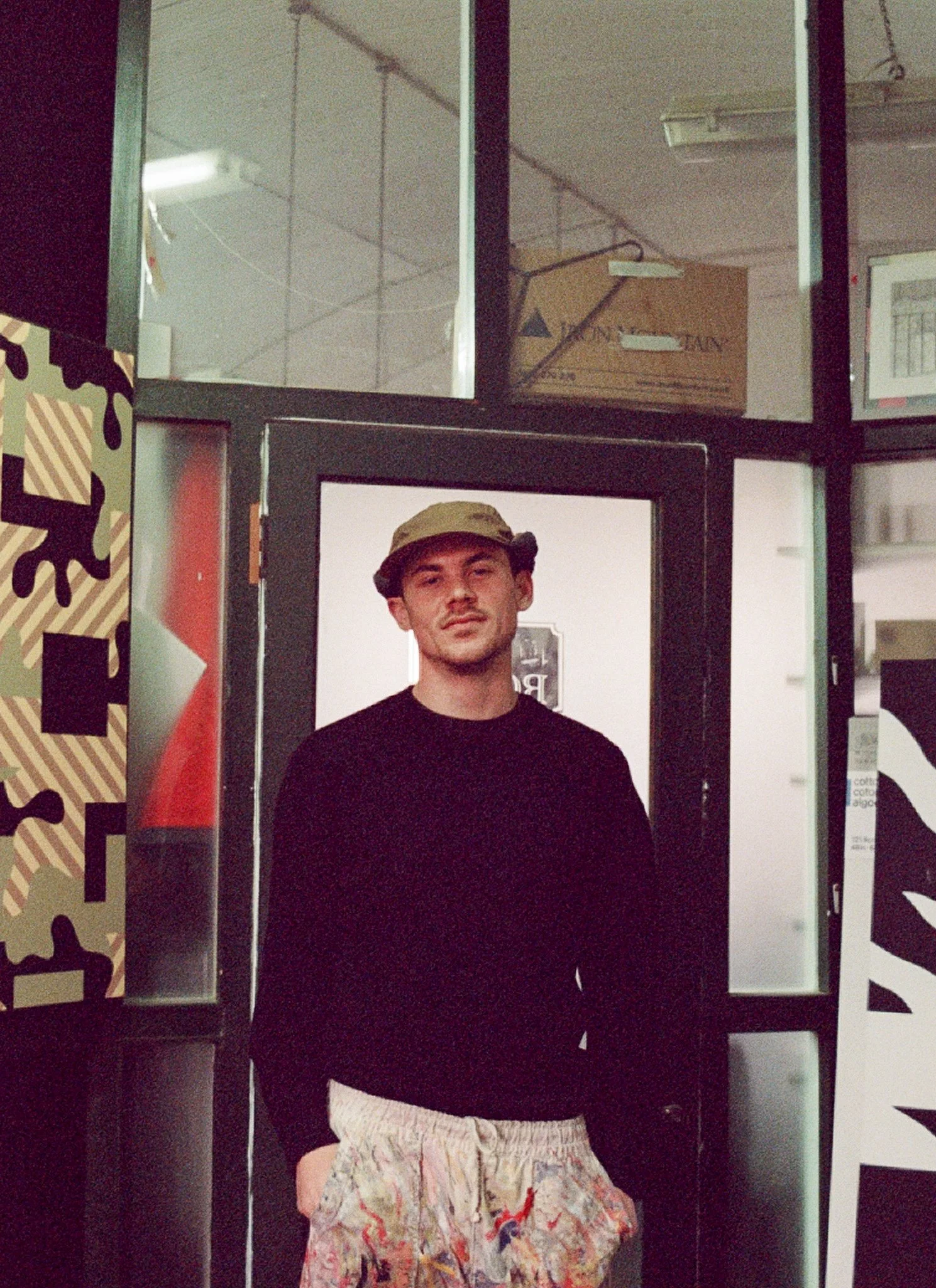
Elliot Winspear is a London-based self-taught artist whose work uses camouflage as a lens through which to examine masculinity, identity and the cost of self-concealment in contemporary culture.
Shaped by a childhood immersed in video games, skate culture and streetwear, most emphatically Call of Duty, A Bathing Ape, and Maharishi, Winspear’s practice positions camouflage as an emblem of a specific cultural moment: the fragmentation of male identity at the intersection of the digital and the real. The same digital world that offers endless distraction and quietly kills ambition has also been the window through which a creative life became possible. Winspear’s work exists in that contradiction, using the tools of a world he is wary of to push against the shyness, self-doubt and low expectation that might otherwise have won.
The paintings are built from a deliberate tension between straight edges and organic curves. The hard geometric forms, influenced by the clean, flat planes of the digital world Winspear grew up in, sit against the organic shapes of traditional camouflage. This is not incidental. It is a formal argument: the straight line as the language of screens and systems, the curve as something older, more human, more feeling.
Flat colour is a conscious choice, not an aesthetic default. Growing up immersed in working-class British culture and looking at the art world from the outside, Winspear’s instinct was often scepticism, a feeling that much of what was presented as meaningful was anything but. The flatness is a demand to be understood clearly, a refusal of obscurity. There is an irony in this that Winspear is aware of: a body of work built around camouflage that insists on visibility. The pattern hides; the painting wants to be seen.
That tension runs through the work personally as much as formally. The surface of the work is smooth and controlled, giving little away. This is a finish that reflects something true about Winspear himself. Not out of indifference, but out of necessity. To exist vulnerably is to risk being walked over. But art is where that armour comes off, where the work is done honestly and independently, in the hope that honest work eventually finds its due reward, even when everything around you suggests it probably won’t.
The camouflage motif, in this sense, is both the subject and the self-portrait. To blend in is a survival strategy. To paint it large, flat and impossible to ignore is the act of resistance.